
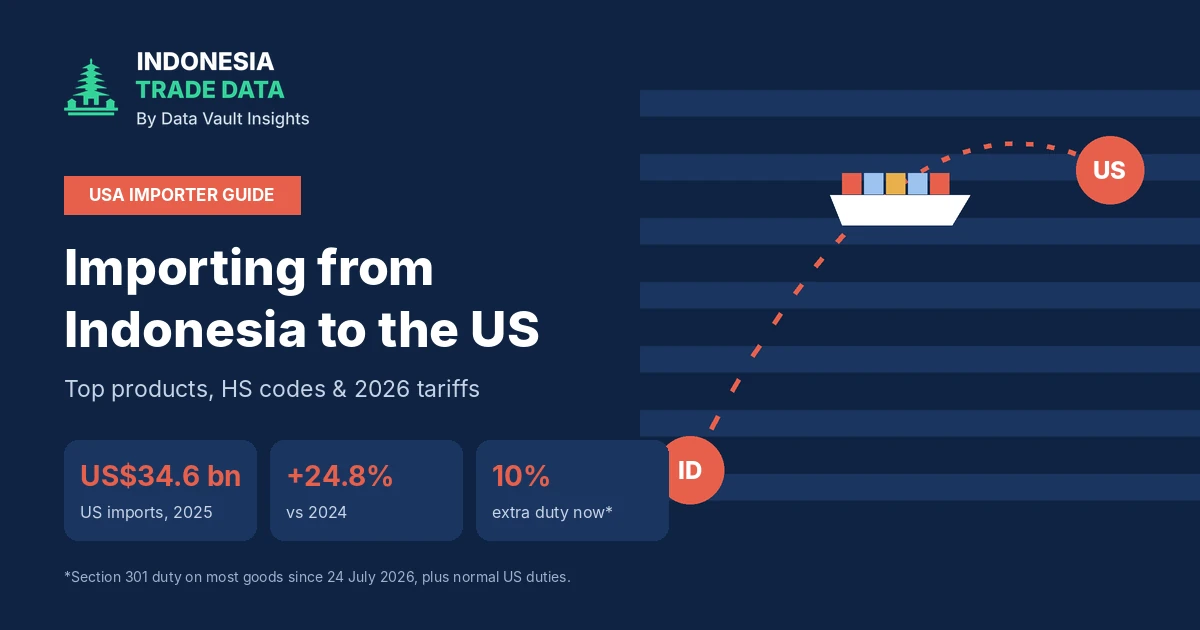
For American importers, Indonesia has quietly become one of the most important sourcing countries in Asia. In 2025 the United States bought US$34.6 billion of goods from Indonesia, up 24.8% on 2024, while US exports to Indonesia were US$10.8 billion. That growth came as many US brands spread their sourcing beyond China and Vietnam.
This guide is written for US buyers. It shows what America imports from Indonesia, the HS codes to search, the tariffs that apply in 2026, and how to find Indonesian suppliers who already ship to the US.
US–Indonesia trade at a glance
| Indicator | 2025 | Change vs 2024 |
|---|---|---|
| US goods imports from Indonesia | US$34.6 bn | +24.8% |
| US goods exports to Indonesia | US$10.8 bn | +7.0% |
| US goods trade deficit with Indonesia | US$23.8 bn | +35.1% |
| Largest product group | Electronics, US$8.1 bn | – |
| Extra US tariff on most Indonesian goods (Oct 2026) | 10% (Section 301) | – |
Headline figures are US government totals. Product values below come from US customs records and add up to a slightly higher US$36.5 bn because of differences in how trade is counted.
What America imports from Indonesia
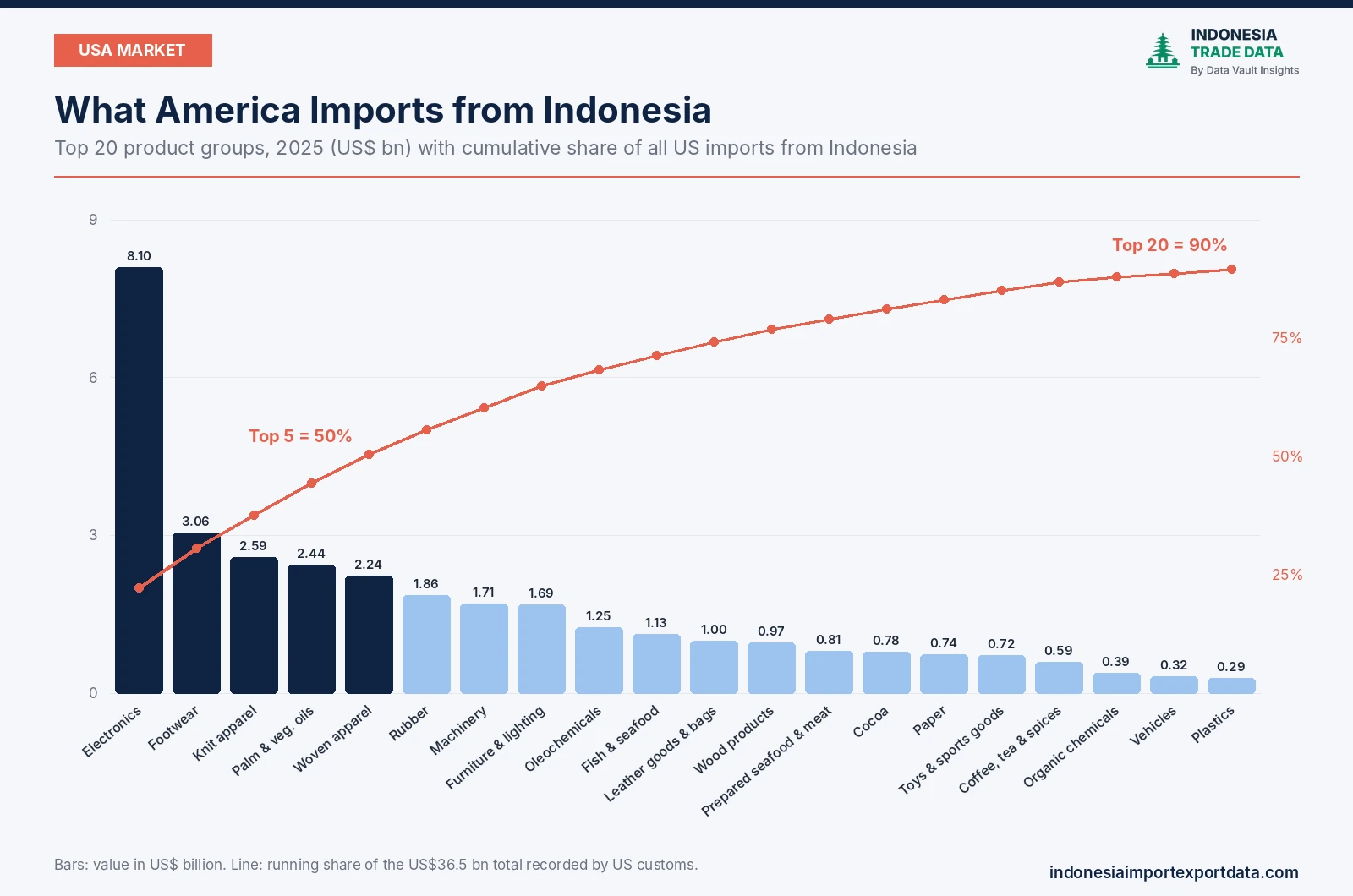
Five product groups make up half of all US imports from Indonesia: electronics, footwear, knitted clothing, palm and vegetable oils, and woven clothing. The top 20 groups cover 90%.
| Rank | HS chapter | Product group | US imports 2025 |
|---|---|---|---|
| 1 | 85 | Electrical & electronic equipment | US$8.10 bn |
| 2 | 64 | Footwear | US$3.06 bn |
| 3 | 61 | Knitted or crocheted apparel | US$2.59 bn |
| 4 | 15 | Animal & vegetable fats and oils (mainly palm oil) | US$2.44 bn |
| 5 | 62 | Woven apparel | US$2.24 bn |
| 6 | 40 | Rubber & rubber products | US$1.86 bn |
| 7 | 84 | Machinery | US$1.71 bn |
| 8 | 94 | Furniture & lighting | US$1.69 bn |
| 9 | 38 | Miscellaneous chemicals (oleochemicals) | US$1.25 bn |
| 10 | 03 | Fish & seafood | US$1.13 bn |
| 11 | 42 | Leather goods, bags & travel goods | US$1.00 bn |
| 12 | 44 | Wood & wood products | US$0.97 bn |
| 13 | 16 | Prepared seafood & meat | US$0.81 bn |
| 14 | 18 | Cocoa & cocoa products | US$0.78 bn |
| 15 | 48 | Paper & paperboard | US$0.74 bn |
| 16 | 95 | Toys, games & sports goods | US$0.72 bn |
| 17 | 09 | Coffee, tea & spices | US$0.59 bn |
| 18 | 29 | Organic chemicals | US$0.39 bn |
| 19 | 87 | Vehicles & parts | US$0.32 bn |
| 20 | 39 | Plastics | US$0.29 bn |
Eight product lines worth sourcing from Indonesia
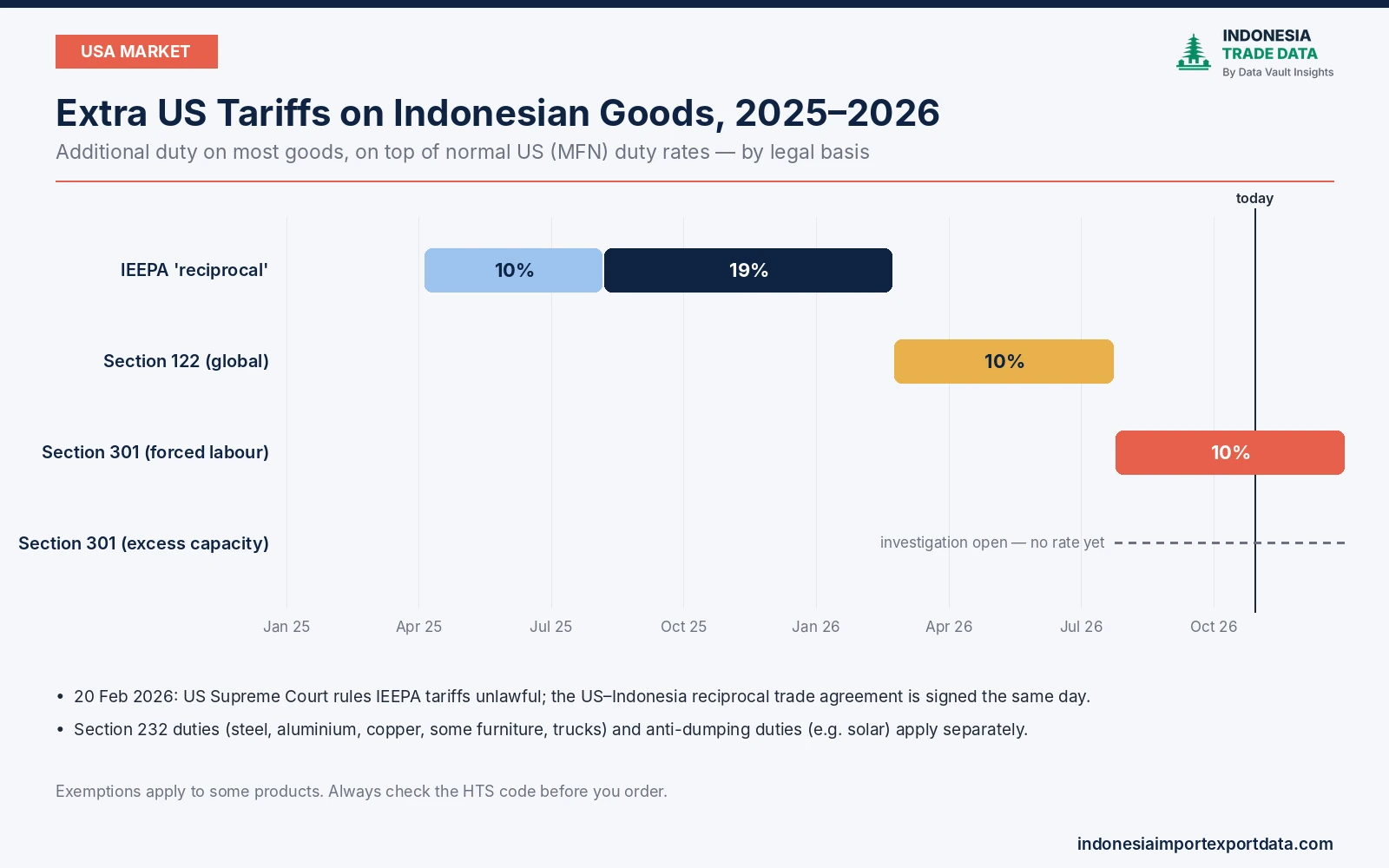
1. Electronics (HS 85) — US$8.10 bn
The biggest and fastest-growing category. Semiconductor devices, mostly solar cells, made up about US$2.2 billion, followed by electrical machines, phone and network equipment, and cables. Note: US anti-dumping and anti-subsidy duties on Indonesian solar cells and panels take effect from November 2026, so solar buyers should check costs carefully.
2. Apparel (HS 61 & 62) — US$4.83 bn
Knitted and woven clothing together make Indonesia a major garment supplier to US retailers. The US is by far the largest market for Indonesian knitwear.
3. Footwear (HS 64) — US$3.06 bn
Indonesia is the third-largest shoe supplier to the US, shipping around 166 million pairs a year, mainly athletic sneakers and leather shoes for global brands.
4. Palm and vegetable oils (HS 15) — US$2.44 bn
Palm oil and palm kernel oil for food manufacturers, bakeries and personal-care makers. Indonesia supplies half of the world's palm oil exports.
5. Seafood (HS 03 & 16) — US$1.94 bn
Fresh, frozen and prepared shrimp, tuna and crab are Indonesia's main seafood exports to the US.
6. Rubber (HS 40) — US$1.86 bn
Natural rubber for US tyre and industrial makers, plus finished tyres and rubber goods.
7. Furniture and lighting (HS 94) — US$1.69 bn
Solid-wood and rattan furniture from Java is popular with US furniture retailers. Note that some upholstered furniture and kitchen cabinets face separate US Section 232 duties.
8. Coffee, spices and cocoa (HS 09 & 18) — US$1.37 bn
Sumatran and Java coffees, vanilla, nutmeg, cinnamon and cocoa products for US roasters, food and confectionery makers.
US tariffs on Indonesian goods in 2026
US tariff rules changed several times over the past 18 months, so it is worth getting the current picture right before you place orders.
| Date | What happened | Extra tariff on most Indonesian goods |
|---|---|---|
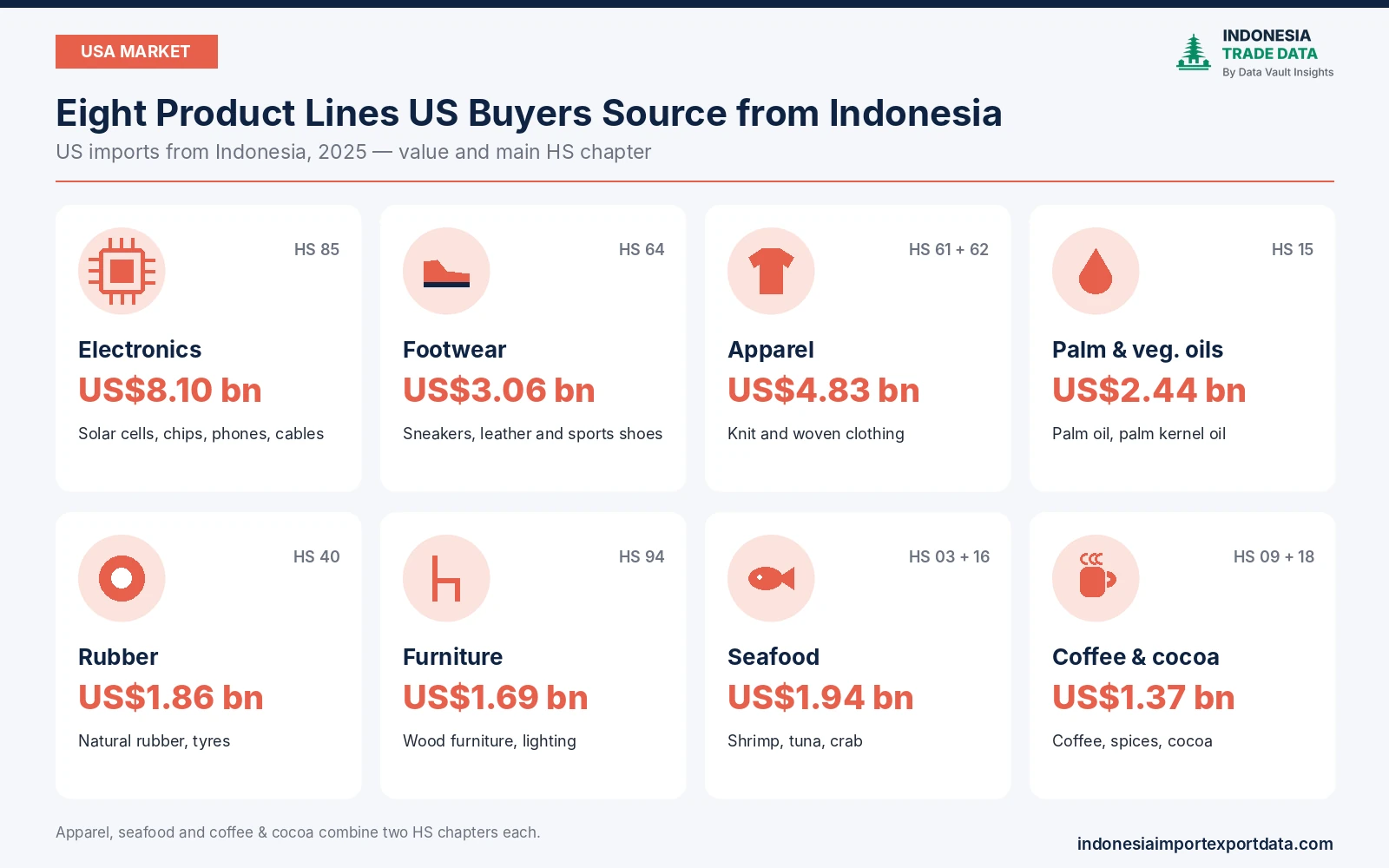
| April 2025 | "Reciprocal" tariffs under IEEPA; 32% announced for Indonesia, then paused | 10% |
| August 2025 | US–Indonesia deal sets the reciprocal rate | 19% |
| 20 February 2026 | Supreme Court rules IEEPA tariffs unlawful; the US–Indonesia Agreement on Reciprocal Trade is signed the same day | IEEPA tariffs stop |
| 24 Feb – 24 Jul 2026 | Temporary global tariff under Section 122 | 10% |
| Since 24 July 2026 | Section 301 duty linked to forced-labour enforcement; Indonesia is in the lower 10% group (others pay 12.5%) | 10%, with exemptions |
| Pending | Section 301 investigation into excess manufacturing capacity | No rate yet |
What this means in practice:
- Most Indonesian goods now pay the normal US duty rate for their HTS code plus 10%.
- Some products are exempt, and tariff-rate quotas are planned for certain textiles and apparel made with US cotton or fibre. Indonesia has also asked for palm oil to be exempted.
- Products covered by Section 232 (steel, aluminium, copper, some furniture, trucks) pay those duties instead, often at higher rates.
- The Agreement on Reciprocal Trade signed in February 2026 lists zero-duty treatment for products including palm oil, coffee, cocoa, spices, rubber and semiconductors. Check how it is being applied to your HTS code.
- A second Section 301 decision, on excess capacity, is still pending and could add to the rate.
Tariffs change quickly. Always confirm the current rate for your exact HTS code with your customs broker before you order.
A checklist for US importers
- Get the HTS code right. The 10-digit US HTS code decides your duty rate, any Section 301 or 232 duty, and whether an exemption applies.
- Check product rules. Food and seafood need FDA registration and prior notice; children's products need CPSC compliance; wood products may need Lacey Act declarations.
- Mind forced-labour rules. US Customs can detain goods linked to forced labour, so ask suppliers for supply-chain traceability documents.
- File on time. Ocean shipments need an Importer Security Filing (ISF) at least 24 hours before loading.
- Check the supplier's US track record. A factory that already ships to US buyers knows the labelling, testing and paperwork your customs broker will ask for.
Find Indonesian suppliers already shipping to the US
The quickest way to shortlist reliable suppliers is to see who is already exporting your product to American buyers. With our Indonesia export data you can filter shipments by destination: United States and by HS code to see each Indonesian exporter, their US buyers, quantities, values, ports and shipping dates, updated every month.
Browse the Indonesian exporter directory, check the HS code list, or request a free sample of US-bound shipment data for your product.
Related guides: What Big Economies Import from Indonesia · Electronics · Footwear · Palm Oil
Indonesia Trade Data supplies shipment records only. We do not buy or sell any goods mentioned here; to trade, contact the companies in the records directly.
Want the shipment data behind this?
Ask for a free sample of Indonesia import or export records for your product.
Related articles
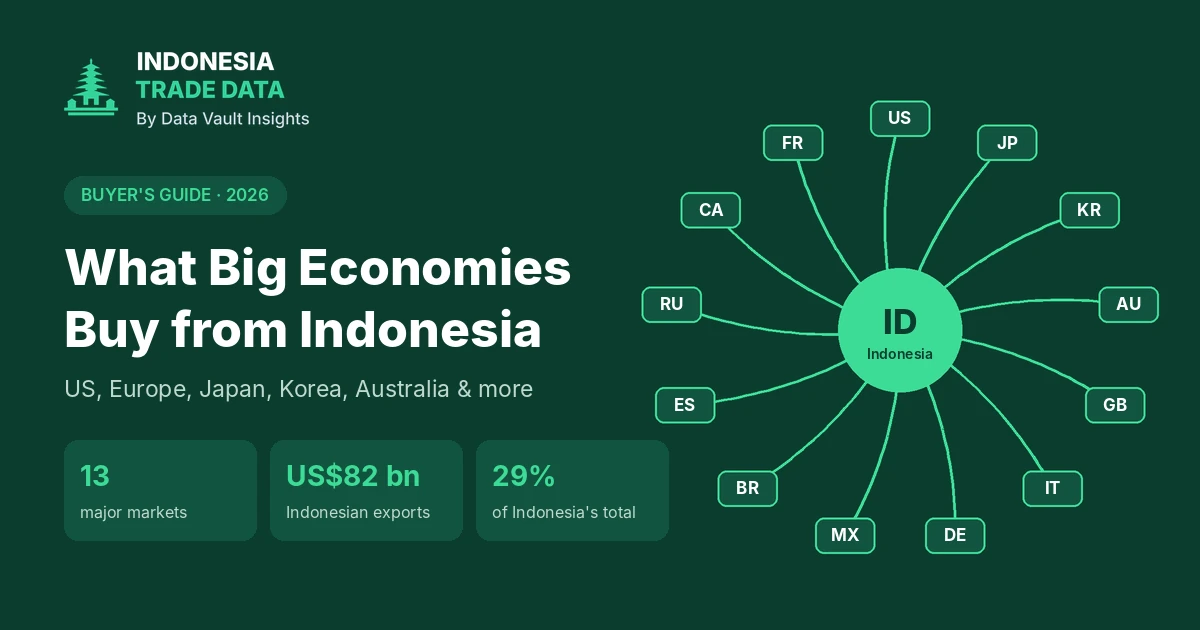
What the US, Europe, Japan & Other Big Economies Import from Indonesia (2026)
Thirteen of the world's largest economies bought about US$82 billion of goods from Indonesia in 2025. This buyer's guide shows what each market imports, from US electronics and footwear to Japanese coal and European palm oil, plus the trade deals that lower duties in 2026 and 2027.
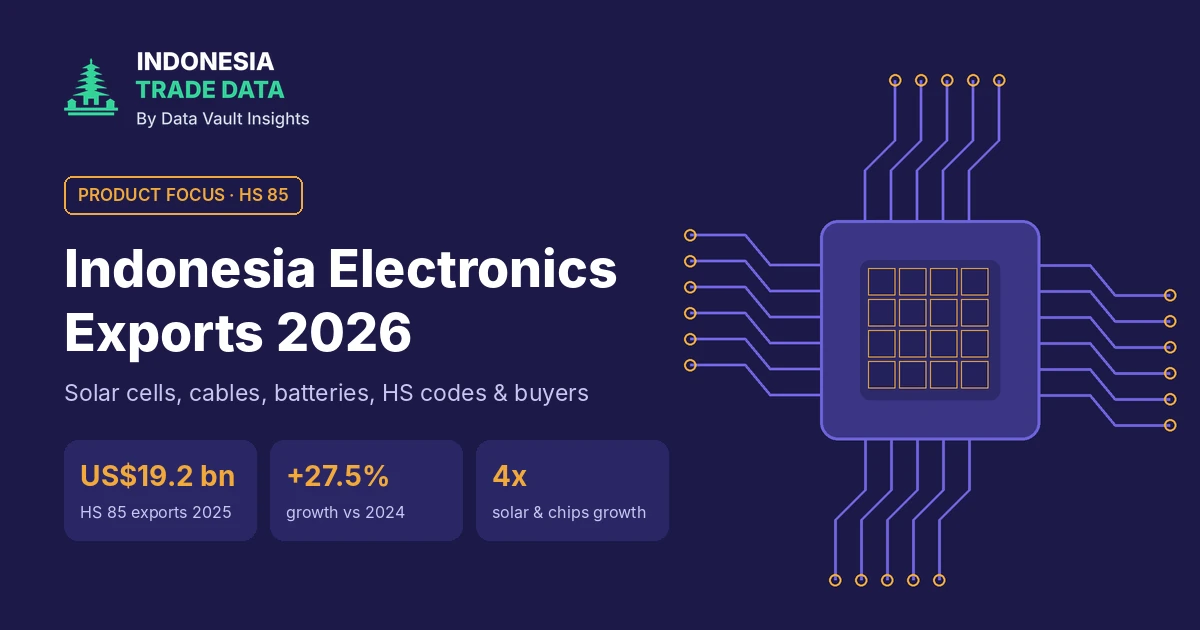
Indonesia Electronics Exports 2026: Solar Cells, HS Codes & Buyers
Indonesia exported US$19.2 billion of electrical and electronic equipment in 2025. Solar cells more than quadrupled, while phones, cables and batteries kept growing. This guide covers HS 85 codes, the top products, the main buyers and the new US solar duties.
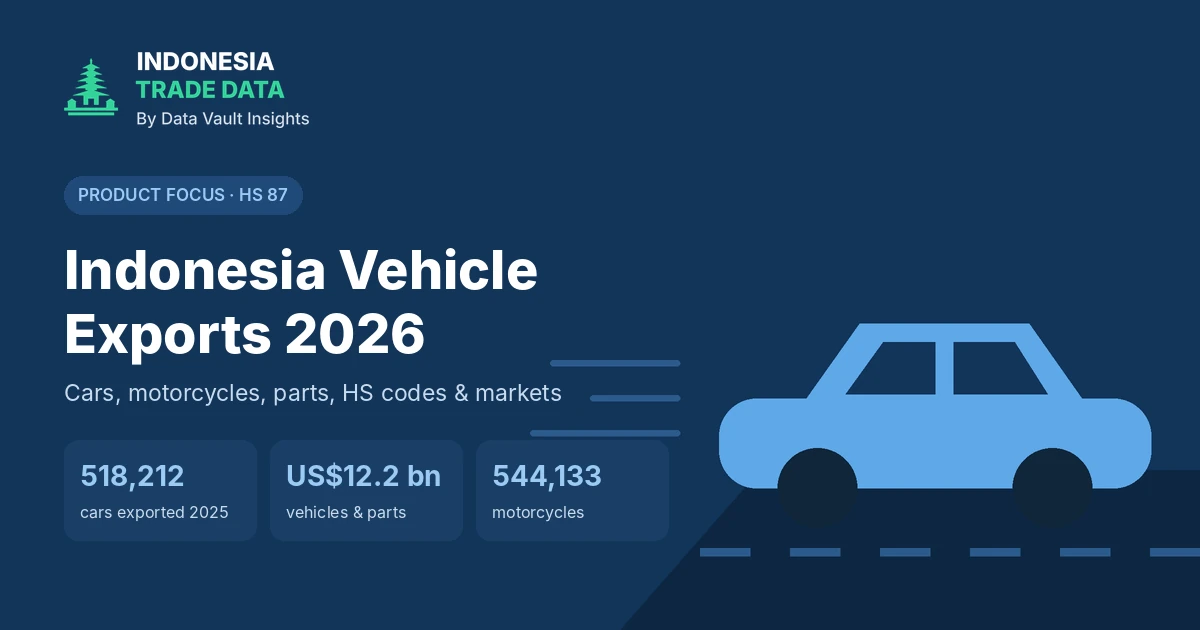
Indonesia Vehicle Exports 2026: Cars, Motorcycles, HS Codes & Markets
Indonesia exported US$12.2 billion of vehicles and parts in 2025, including a record 518,212 fully built cars. This guide covers the HS codes for cars, motorcycles and auto parts, the brands behind the exports, the main buying markets and the 2026 trends.