
If you import goods into the United States, Europe, Japan, Korea, Australia or the Americas, Indonesia is probably already in your supply chain, even if you have never bought from an Indonesian company directly. In 2025 thirteen of the world's largest economies bought about US$82 billion of goods from Indonesia, close to 29% of everything the country exports.
But each market buys something different. Americans buy Indonesian electronics, clothing and shoes. Japan and Korea buy coal, nickel and electronics. Southern Europe and Brazil buy palm oil and steel. This guide breaks it down market by market, so you can see what your competitors are already importing and where the opportunities are.
Indonesia's exports to 13 major economies at a glance
| Rank | Market | Imports from Indonesia, 2025 | Top 3 products from Indonesia |
|---|---|---|---|
| 1 | United States | US$31.02 bn | Electronics, knit apparel, footwear |
| 2 | Japan | US$17.61 bn | Coal & fuels, electronics, nickel |
| 3 | South Korea | US$10.14 bn | Coal & fuels, electronics, iron & steel |
| 4 | Australia | US$3.73 bn | Electronics, machinery, inorganic chemicals |
| 5 | United Kingdom* | US$2.93 bn | Footwear, nickel, electronics |
| 6 | Italy | US$2.83 bn | Iron & steel, palm & vegetable oils, chemicals |
| 7 | Germany | US$2.51 bn | Machinery, coffee & spices, electronics |
| 8 | Mexico | US$2.45 bn | Vehicles, electronics, footwear |
| 9 | Brazil | US$2.21 bn | Palm & vegetable oils, vehicles, electronics |
| 10 | Spain | US$1.81 bn | Palm & vegetable oils, iron & steel, chemicals |
| 11 | Russia** | About US$1.75 bn | Palm & vegetable oils, cocoa, coffee & spices |
| 12 | Canada | US$1.70 bn | Electronics, wood pulp, rubber |
| 13 | France | US$1.09 bn | Electronics, cocoa, vehicles |
North America
United States: Indonesia's biggest Western customer
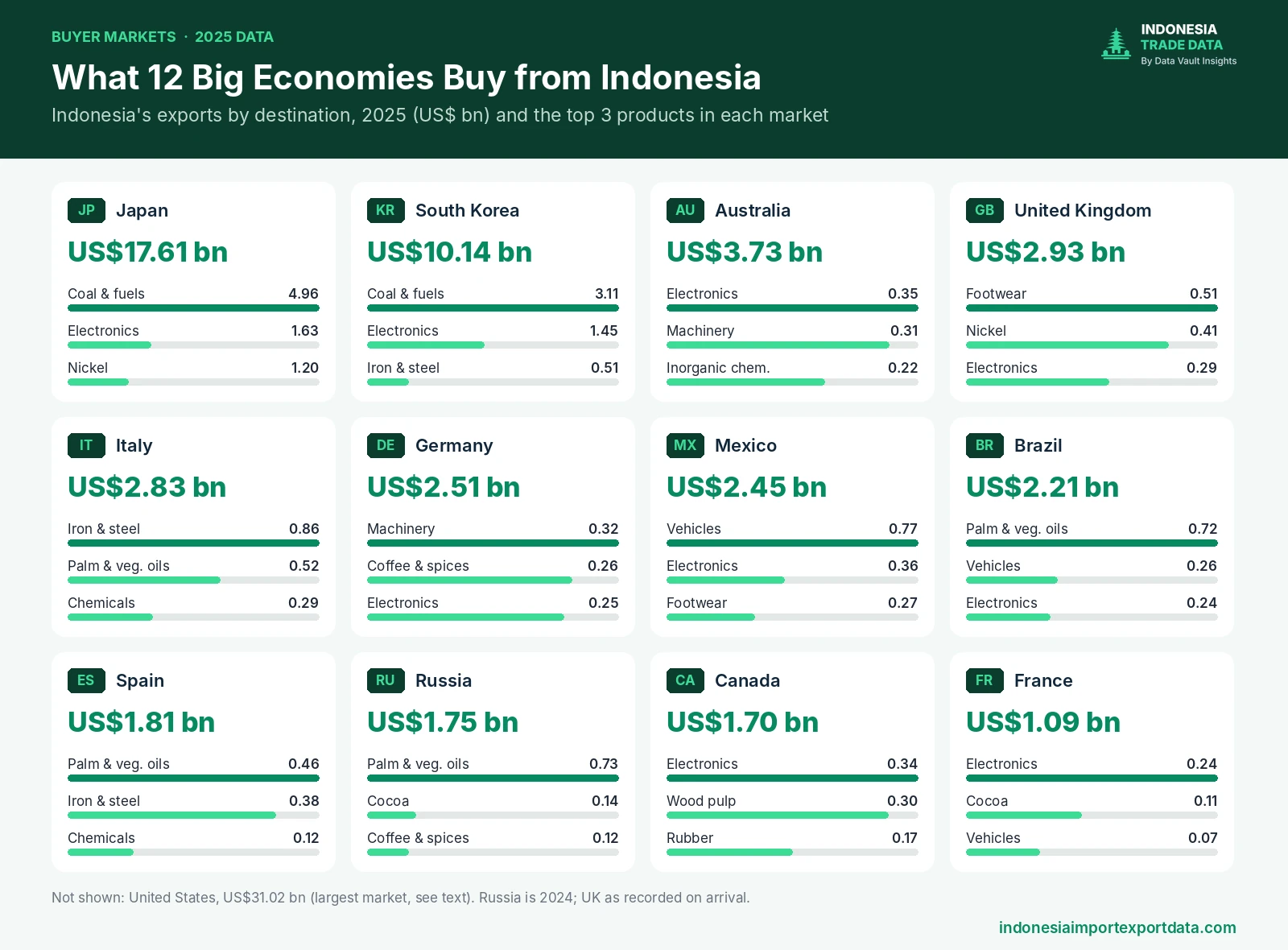
The US bought US$31.02 billion of Indonesian goods in 2025, more than any market except China. It is a consumer-goods market: electronics (US$6.03 bn, led by solar cells and semiconductors), knitted clothing (US$2.81 bn), footwear (US$2.80 bn), woven clothing (US$2.10 bn) and palm and vegetable oils (US$2.06 bn) are the top five.
For US importers: Indonesian goods face a 19% reciprocal tariff under the 2025 deal, lower than many rival suppliers were threatened with. Solar cells and panels are the exception: heavy anti-dumping and anti-subsidy duties apply from November 2026.
Mexico: cars and shoes
Mexico bought US$2.45 billion from Indonesia, led by vehicles (US$773 m), electronics (US$365 m) and footwear (US$269 m).
Canada: a new trade deal from December 2026
Canada imported US$1.70 billion from Indonesia, including electronics (US$335 m), wood pulp (US$296 m), rubber (US$168 m) and footwear (US$161 m). The Indonesia–Canada CEPA takes effect on 1 December 2026, with Canada liberalising 90.55% of its tariff lines, which should make Indonesian goods cheaper to land.
Europe
United Kingdom: footwear first
The UK recorded US$2.93 billion of imports from Indonesia. Footwear leads (US$510 m), followed by nickel (US$411 m), electronics (US$294 m), wood products (US$156 m) and clothing (US$120 m).
Italy: steel and palm oil
Italy bought US$2.83 billion, mostly industrial inputs: iron and steel (US$858 m), palm and vegetable oils (US$522 m) and oleochemicals (US$294 m).
Germany: machinery, coffee and electronics
Germany bought US$2.51 billion, with a broad mix: machinery (US$317 m), coffee, tea and spices (US$263 m), electronics (US$247 m), clothing (US$188 m) and footwear (US$167 m).
Spain: palm oil and steel
Spain imported US$1.81 billion, led by palm and vegetable oils (US$456 m), iron and steel (US$377 m) and oleochemicals (US$123 m).
France: electronics and cocoa
France bought US$1.09 billion: electronics (US$239 m), cocoa (US$111 m), vehicles (US$71 m), furniture (US$53 m) and cosmetics ingredients (US$52 m).
For EU importers: the Indonesia–EU CEPA is targeted to take effect on 1 January 2027, with the EU removing tariffs on 98.5% of tariff lines. Footwear, clothing, furniture and processed foods from Indonesia are expected to become cheaper to import.
Russia: palm oil and food
Russia imported about US$1.75 billion from Indonesia in 2024, mostly food: palm oil (US$734 m), cocoa (US$140 m) and coffee, tea and spices (US$116 m). A free trade agreement with the Eurasian Economic Union was signed in December 2025 and is expected to take effect in 2027.
Asia-Pacific
Japan: energy and metals
Japan is Indonesia's second-biggest market among the large economies, at US$17.61 billion. Coal and fuels lead (US$4.96 bn), followed by electronics (US$1.63 bn, mainly wiring and cables), nickel (US$1.20 bn), machinery (US$868 m) and rubber (US$781 m). Trade has run under the Japan–Indonesia EPA since 2008.
South Korea: coal, electronics and steel
South Korea bought US$10.14 billion: coal and fuels (US$3.11 bn), electronics (US$1.45 bn), iron and steel (US$508 m), oleochemicals (US$467 m) and ores (US$453 m). The Korea–Indonesia CEPA has applied since 2023.
Australia: a diverse, duty-free market
Australia imported US$3.73 billion, spread across electronics (US$350 m), machinery (US$314 m), inorganic chemicals (US$220 m), steel products (US$218 m) and footwear (US$197 m). Under IA-CEPA, in force since 2020, Indonesian goods enter Australia duty-free.
Brazil: palm oil and cars
Brazil bought US$2.21 billion from Indonesia, led by palm and vegetable oils (US$720 m), vehicles (US$263 m), electronics (US$238 m), rubber (US$179 m) and fuels (US$153 m).
Which products sell where
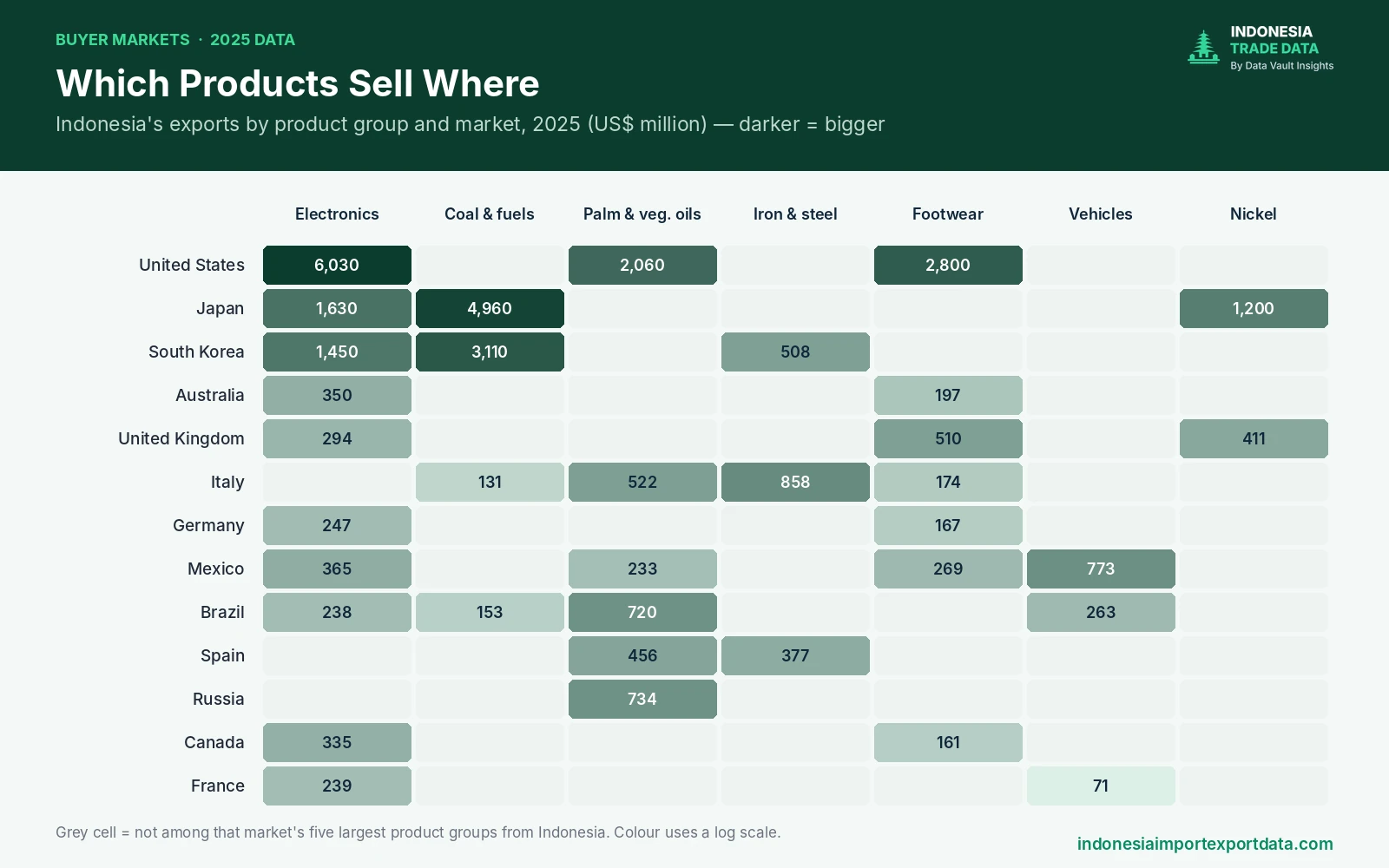
The heatmap below shows how each market's shopping list differs. Electronics sell almost everywhere. Coal goes mainly to Japan and Korea. Palm oil is strongest in Brazil, Russia and southern Europe. Footwear is big in the US and UK, and vehicles in Mexico.
Trade deals that lower your costs
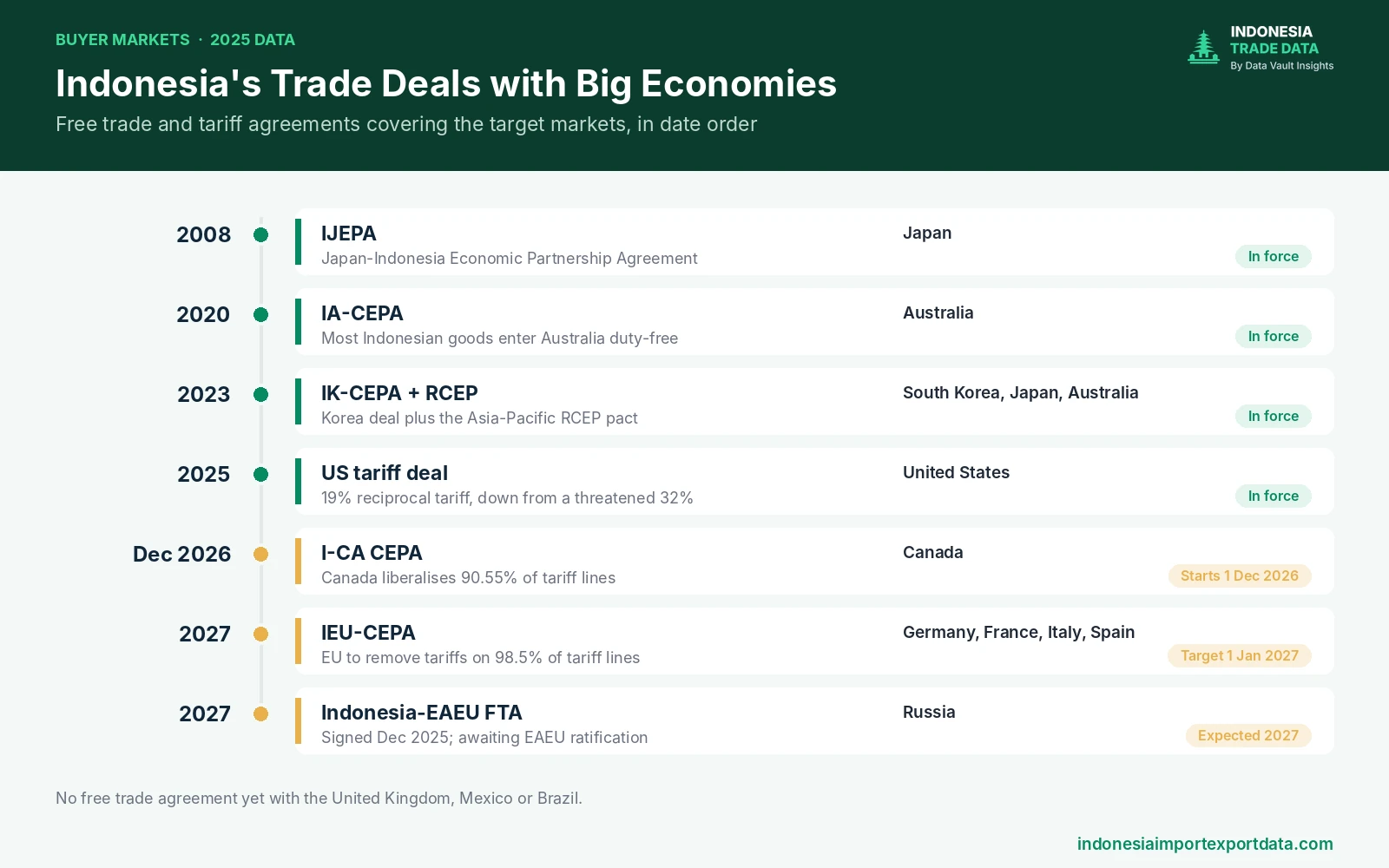
Indonesia already has trade agreements with Japan, Korea and Australia, and new deals with Canada, the EU and the Eurasian Economic Union are about to start. Importers in these markets can often bring in Indonesian goods at low or zero duty with the right certificate of origin.
| Market | Agreement | Status |
|---|---|---|
| Japan | Japan–Indonesia EPA (IJEPA), plus RCEP | In force since 2008 |
| Australia | IA-CEPA, plus RCEP | In force since 2020 |
| South Korea | IK-CEPA, plus RCEP | In force since 2023 |
| United States | Reciprocal tariff deal (19%) | In force since 2025 |
| Canada | I-CA CEPA | Starts 1 December 2026 |
| Germany, France, Italy, Spain | IEU-CEPA | Targeted for 1 January 2027 |
| Russia | Indonesia–EAEU FTA | Signed December 2025; expected 2027 |
| United Kingdom, Mexico, Brazil | No free trade agreement yet | Standard tariffs apply |
How to find the right Indonesian supplier
- Start from the product, not the country. Pick the exact 6- or 8-digit HS code for what you buy, then look at which Indonesian companies ship it.
- Check who already ships to your market. A supplier that already exports to the US, EU or Japan understands your labelling, testing and paperwork rules.
- Compare prices across shipments. Shipment-level values let you benchmark what other importers in your country pay.
- Use the trade deals. Ask suppliers for the right certificate of origin so you pay the lower tariff where an agreement applies.
Get Indonesia export data for your market
Annual totals show where trade is flowing. Shipment records show who is behind it. With our Indonesia export data you can filter shipments by destination country and HS code to see every Indonesian exporter, the foreign buyer, quantity, value and port, updated every month. That means you can find the Indonesian suppliers already shipping to the US, Germany, Japan or any other market on this list.
Browse the Indonesian exporter directory, check the HS code list, or request a free sample for your country and product.
Product guides: Palm Oil · Coal · Nickel · Footwear · Vehicles · Electronics
Indonesia Trade Data supplies shipment records only. We do not buy or sell any goods mentioned here; to trade, contact the companies in the records directly.
Want the shipment data behind this?
Ask for a free sample of Indonesia import or export records for your product.
Related articles
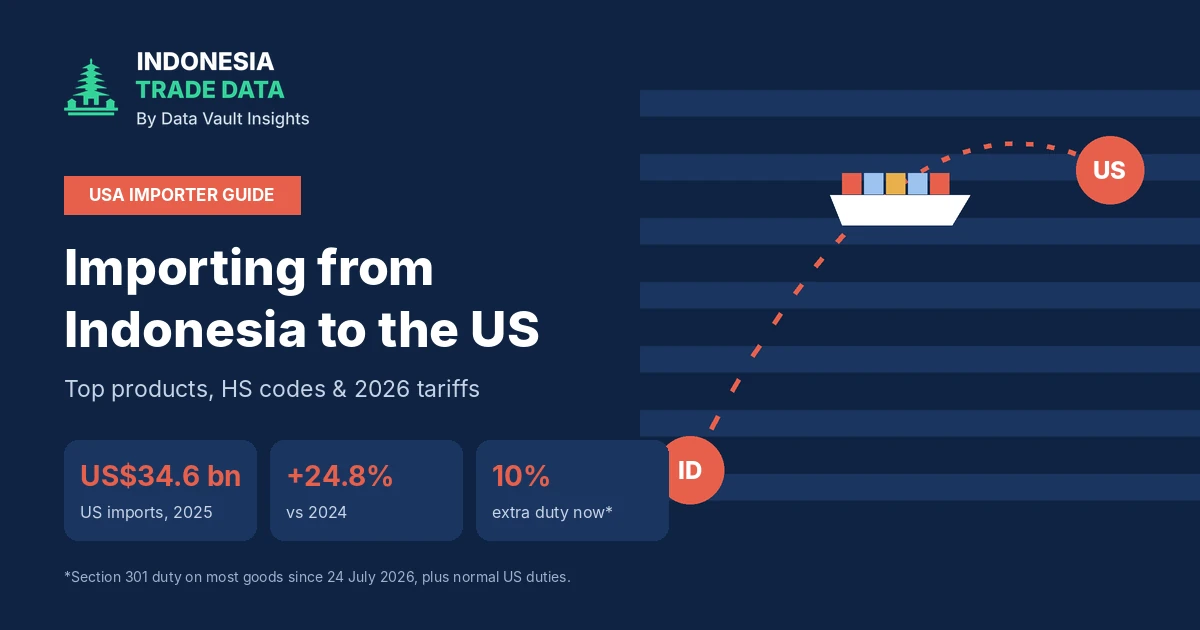
Importing from Indonesia to the USA in 2026: Top Products, HS Codes & Tariffs
The US is Indonesia's biggest Western market, with imports up 24.8% to US$34.6 billion in 2025. This guide for American importers covers the top products and HS codes, the tariffs in force in 2026, and how to find Indonesian suppliers already shipping to the US.
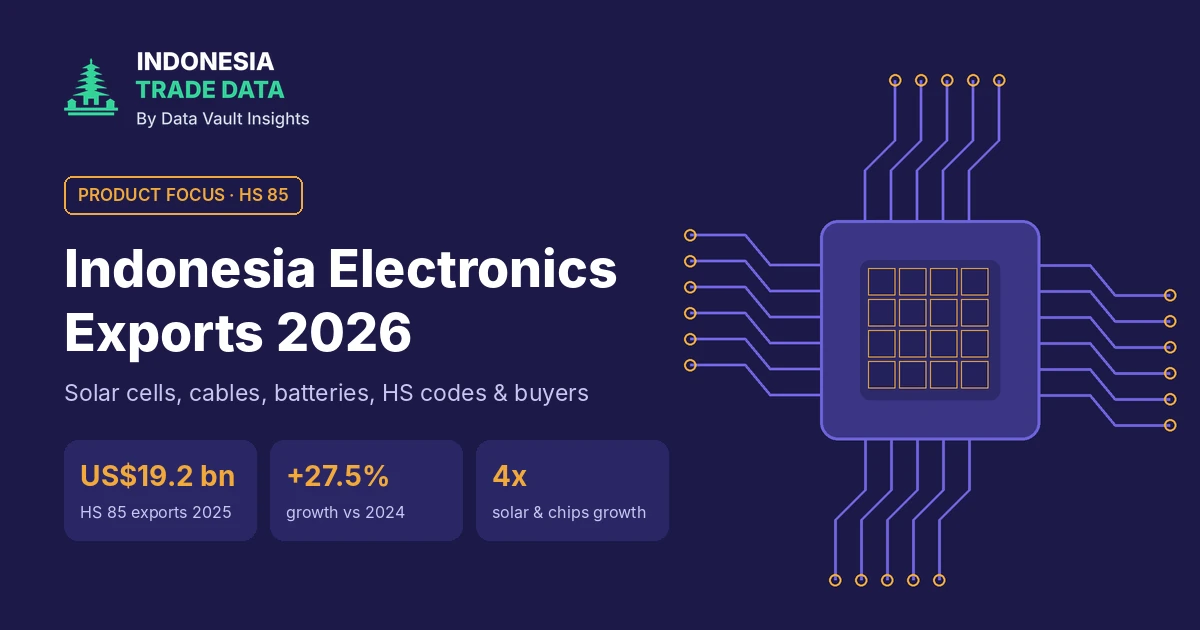
Indonesia Electronics Exports 2026: Solar Cells, HS Codes & Buyers
Indonesia exported US$19.2 billion of electrical and electronic equipment in 2025. Solar cells more than quadrupled, while phones, cables and batteries kept growing. This guide covers HS 85 codes, the top products, the main buyers and the new US solar duties.
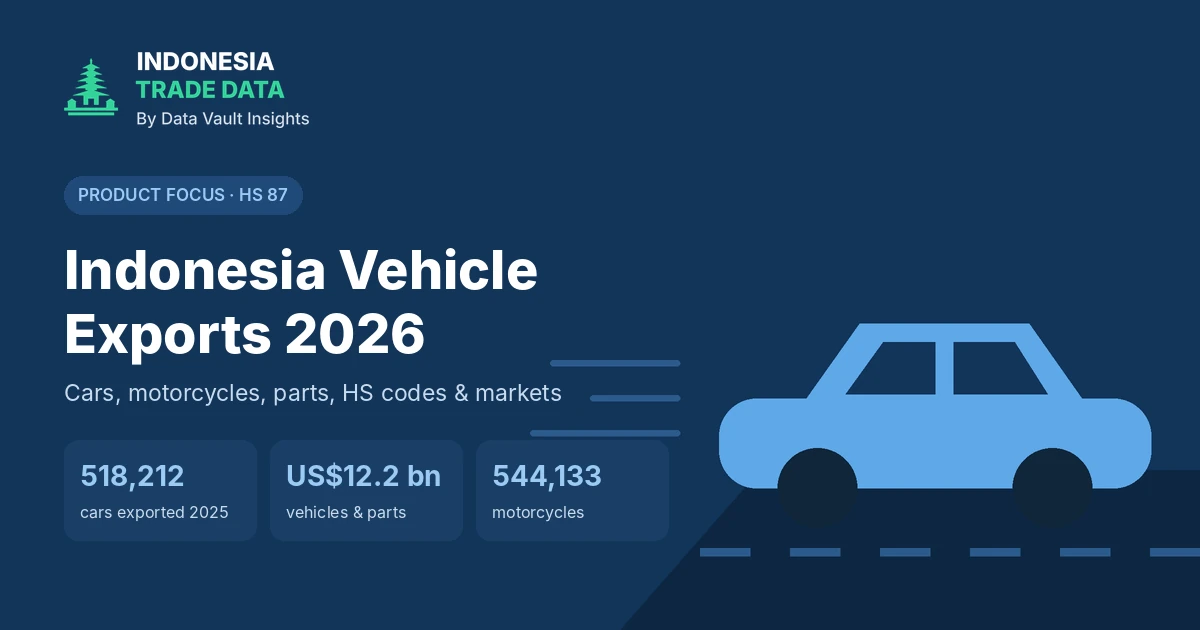
Indonesia Vehicle Exports 2026: Cars, Motorcycles, HS Codes & Markets
Indonesia exported US$12.2 billion of vehicles and parts in 2025, including a record 518,212 fully built cars. This guide covers the HS codes for cars, motorcycles and auto parts, the brands behind the exports, the main buying markets and the 2026 trends.