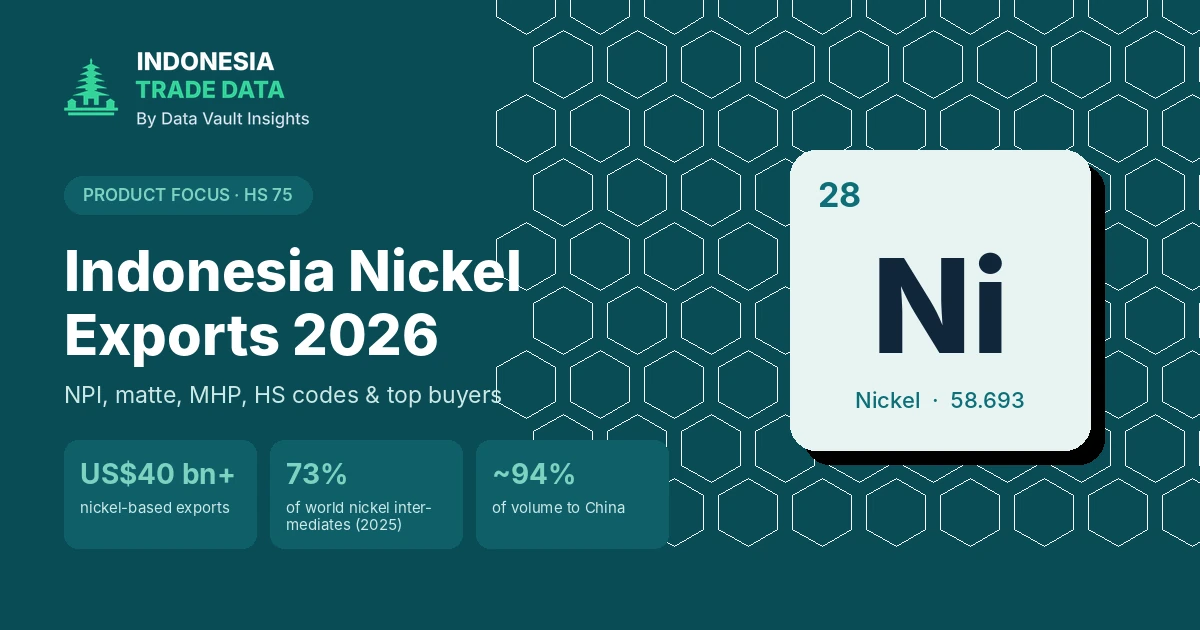
Ten years ago Indonesia mostly dug up nickel ore and shipped it abroad for others to process. Today it is the centre of the world's nickel industry. Since January 2020, exporting raw nickel ore has been banned, so the ore is smelted in Indonesia and sold as nickel pig iron, ferronickel, nickel matte, MHP and stainless steel.
The result has been dramatic. Nickel-based exports were worth about US$3.3 billion in 2017–2018. By 2025 they had passed US$40 billion, and the government is targeting at least US$45 billion in 2026. Here is what Indonesia ships, how to find it by HS code, and who is buying.

Indonesia nickel exports at a glance
| Indicator | Figure |
|---|---|
| Nickel-based product exports, 2025 | Over US$40 bn |
| Nickel-based product exports, 2024 | US$33.6 bn |
| Export target, 2026 | At least US$45 bn |
| Nickel ore mined, 2025 | About 320 million tonnes |
| Indonesia's share of world nickel intermediates (MHP + matte) | 73% in 2025, up from 22% in 2021 |
| Processing plants | About 80: 55 RKEF smelters, 10 HPAL plants, 10 matte plants, 6 integrated stainless steel plants |
The nickel value chain: from ore to export
Indonesian nickel ore comes in two types, and each goes down a different path:
- Saprolite (higher grade) is melted in rotary-kiln electric furnaces (RKEF) to make nickel pig iron (NPI) and ferronickel, mainly for stainless steel.
- Limonite (lower grade) is leached with acid in high-pressure plants (HPAL) to make mixed hydroxide precipitate (MHP), the key feed for EV battery chemicals.
- Some NPI is converted into nickel matte, which can go to either stainless steel or battery refiners.

Nickel HS codes: what to search for
Indonesian nickel products are spread across several HS chapters. If you only search HS 75, you will miss the biggest one: ferronickel and NPI are classed as ferroalloys under HS 72.
| HS code | Product | Main use |
|---|---|---|
| 2604.00 | Nickel ore and concentrates | Export banned since 2020 (Indonesia now imports some ore) |
| 7202.60 | Ferronickel and nickel pig iron (NPI) | Stainless steel |
| 7501.10 | Nickel matte | Battery-grade nickel sulphate, refined nickel |
| 7501.20 | Nickel oxide sinters and intermediates, including MHP | EV battery precursors |
| 7502.10 | Unwrought nickel, not alloyed (refined nickel) | Alloys, plating, batteries |
| 2833.24 | Nickel sulphate | Battery cathodes |
| 7218 / 7219 | Stainless steel slabs and flat-rolled stainless steel | Construction, appliances, industry |
You can follow monthly shipments under HS 75 nickel and HS 72 iron and steel.
Export values by product (2025)
| HS code | Product | Export value 2025 | Change vs 2024 |
|---|---|---|---|
| 7202 | Ferroalloys (mostly ferronickel and NPI) | US$16.5 bn | +17.2% |
| 7501 | Nickel matte, MHP and other intermediates | US$8.4 bn | +17.4% |
| 7219 | Flat-rolled stainless steel | US$5.4 bn | -7.1% |
| 7218 | Stainless steel ingots and semi-finished | US$2.4 bn | +2.3% |
| 7502 | Refined (unwrought) nickel | US$1.4 bn | +57.4% |
| 75 | Total nickel chapter (7501 + 7502 + others) | US$9.7 bn | +21.7% |
Two trends stand out. Refined nickel is the fastest grower as new refineries come online, and battery-grade MHP output rose by more than a third in 2025, to an estimated 445,000 tonnes of nickel content. High-grade nickel matte output, by contrast, fell by about a fifth as producers shifted capacity.
Who buys Indonesia's nickel?
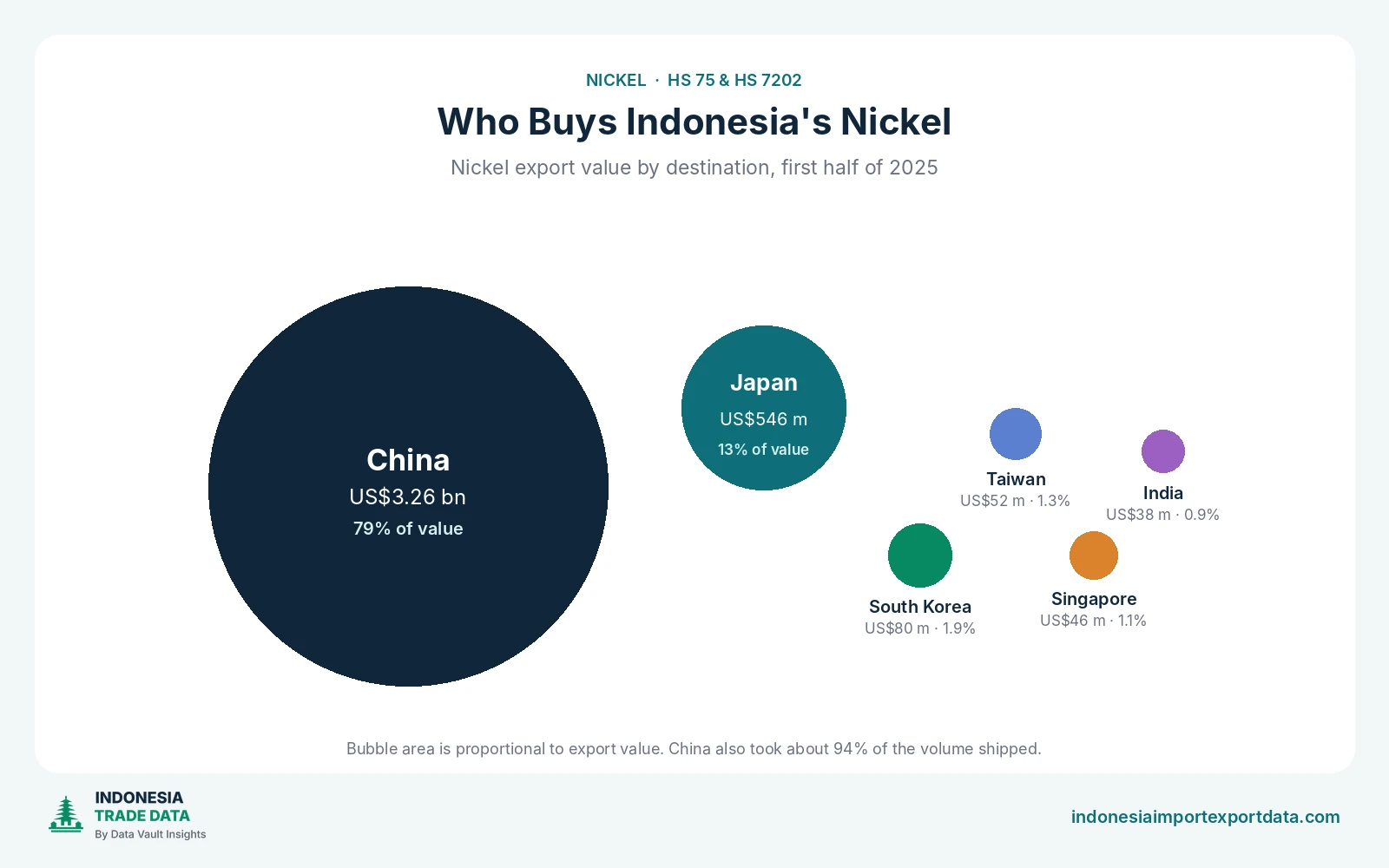
China dominates. In the first half of 2025, China took about 94% of nickel export volume and 79% of the value. Chinese companies also own or co-own many of the smelters in Sulawesi and North Maluku, so much of this trade flows within the same groups. Japan is a clear second, buying higher-grade products for its battery and alloy makers.
| Rank | Destination | Export value, H1 2025 | Share of value |
|---|---|---|---|
| 1 | China | US$3.26 bn | 79% |
| 2 | Japan | US$546.5 m | 13.3% |
| 3 | South Korea | US$79.9 m | 1.9% |
| 4 | Taiwan | US$52.5 m | 1.3% |
| 5 | Singapore | US$45.5 m | 1.1% |
| 6 | India | US$37.8 m | 0.9% |
Exports to China grew 9.0% in volume and 21.2% in value compared with H1 2024.
2026: smaller mining quotas, more imported ore
The biggest change this year is on the supply side. The government cut the 2026 nickel ore mining quota (RKAB) to roughly 260 million tonnes, well below the 379 million tonnes approved for 2025. The goal is to match mining to smelter capacity and slow the depletion of high-grade ore.
| Change in 2026 | Detail | What it means |
|---|---|---|
| Ore quota cut | About 260 Mt, down roughly a third from the 2025 quota | Less ore for smelters; supports nickel prices |
| Price reaction | Nickel rose about 21% in the month to mid-January 2026, to around US$17,900/t | Higher export prices, tighter margins for smelters |
| Ore imports | Imports from the Philippines hit 8.57 Mt in H1 2026 (+65%), with about 25 Mt expected for the year | Smelters now rely partly on foreign ore |
| Export duties | Export duty rates for nickel products were approved in principle in March 2026; details still being finalised | Check the final rules before agreeing long-term prices |
If every smelter ran at full capacity, Indonesia would need around 415 million tonnes of ore a year, far above the 2026 quota. Expect some plants to run below capacity and the product mix to keep shifting towards higher-value refined nickel and battery materials.
What this means for buyers and exporters
- Battery materials are the growth story. MHP, nickel sulphate and refined nickel are rising fastest, as more HPAL and refining capacity starts up.
- Supply is tighter in 2026. Smaller ore quotas mean fewer spare cargoes of NPI and ferronickel, so buyers should secure contracts early.
- Diversify beyond China. Japan, Korea and India are small but growing buyers, and non-Chinese battery makers are looking for traceable Indonesian supply.
- Know the exact HS code. Ferronickel (7202.60), matte (7501.10) and MHP (7501.20) have very different buyers and prices.
Find nickel buyers and suppliers in Indonesia
Annual totals show where the market is going. Shipment records show who is actually trading. With our Indonesia export data you can search nickel shipments by 8-digit HS code and see the exporter, foreign buyer, quantity, value, port and destination, updated every month.
Browse the Indonesian exporter directory, check the HS code list, or request a free sample of nickel export data.
Also read: Top 10 Products Indonesia Exports in 2026, Indonesia Coal Exports 2026 and Indonesia Palm Oil Exports 2026.
Indonesia Trade Data supplies shipment records only. We do not buy or sell any goods mentioned here; to trade, contact the companies in the records directly.
Want the shipment data behind this?
Ask for a free sample of Indonesia import or export records for your product.
Related articles
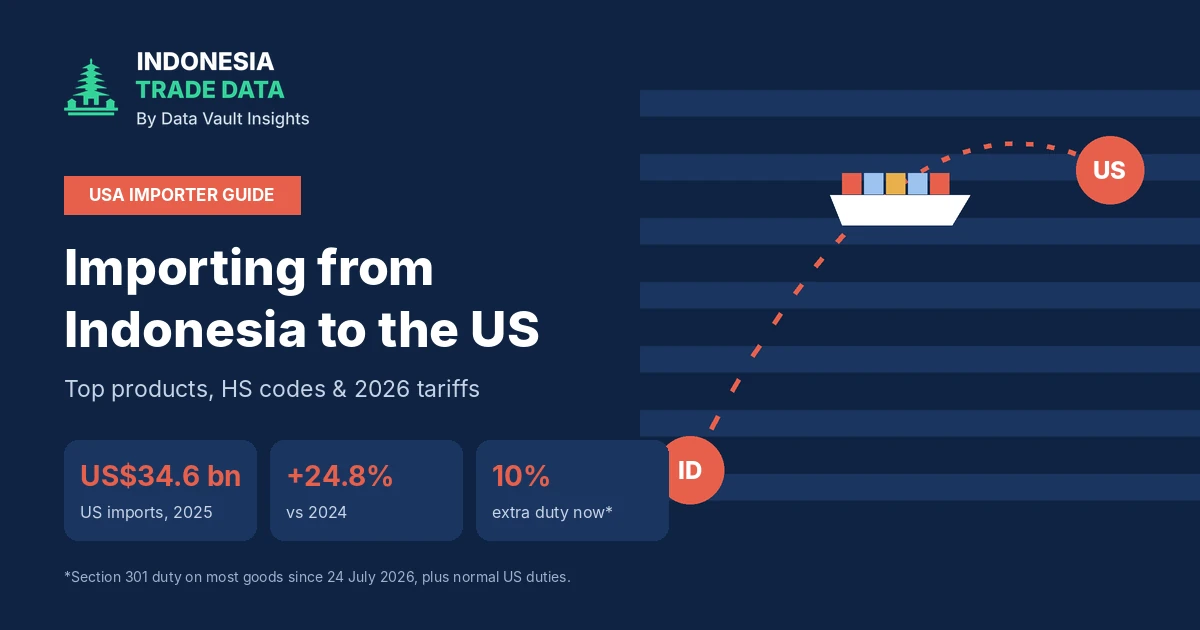
Importing from Indonesia to the USA in 2026: Top Products, HS Codes & Tariffs
The US is Indonesia's biggest Western market, with imports up 24.8% to US$34.6 billion in 2025. This guide for American importers covers the top products and HS codes, the tariffs in force in 2026, and how to find Indonesian suppliers already shipping to the US.
What the US, Europe, Japan & Other Big Economies Import from Indonesia (2026)
Thirteen of the world's largest economies bought about US$82 billion of goods from Indonesia in 2025. This buyer's guide shows what each market imports, from US electronics and footwear to Japanese coal and European palm oil, plus the trade deals that lower duties in 2026 and 2027.
Indonesia Electronics Exports 2026: Solar Cells, HS Codes & Buyers
Indonesia exported US$19.2 billion of electrical and electronic equipment in 2025. Solar cells more than quadrupled, while phones, cables and batteries kept growing. This guide covers HS 85 codes, the top products, the main buyers and the new US solar duties.