
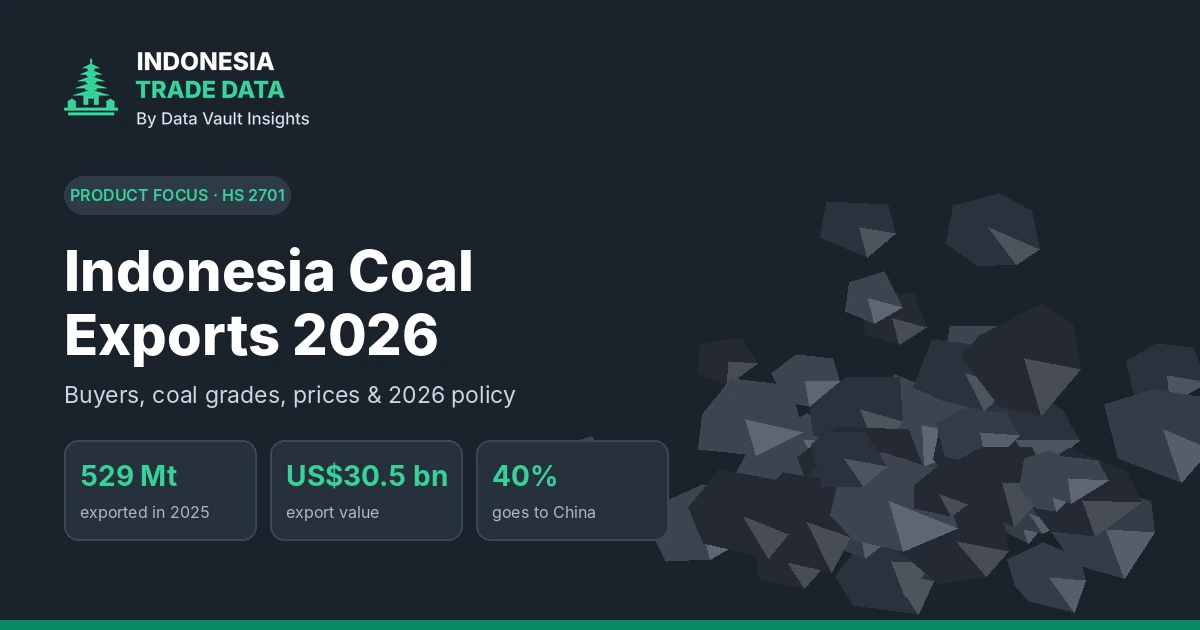
Coal is still Indonesia's single most valuable export product. The country ships more thermal coal by sea than any other nation, and power plants from Guangdong to Gujarat to Manila depend on it. But 2025 was a turning point: after five straight years of growth, Indonesia's coal exports fell, and 2026 has brought production cuts and new export rules.
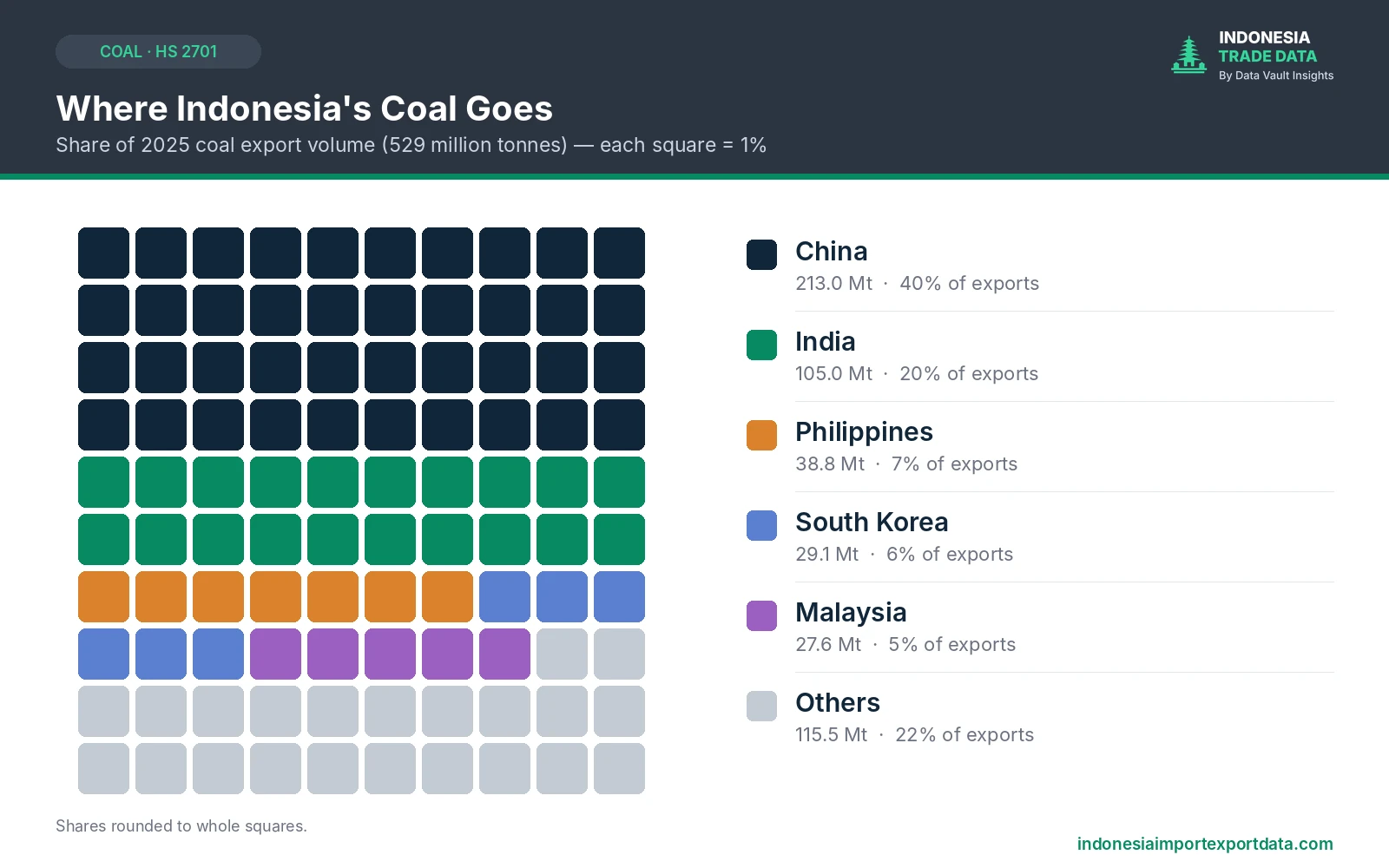
In 2025 Indonesia exported 529 million tonnes of coal worth US$30.5 billion. Volume dropped 6.4%, but value fell much harder, by 20.5%, because the average price slid from about US$68.8 to US$58.4 per tonne. Here is the full picture.
Indonesia coal exports at a glance
| Indicator | 2024 | 2025 | Change |
|---|---|---|---|
| Export volume | 566 Mt | 529 Mt | -6.4% |
| Export value | US$38.4 bn | US$30.5 bn | -20.5% |
| Average export price | US$68.8/t | US$58.4/t | -15.0% |
| Thermal coal volume | 538 Mt | 504 Mt | -6.3% |
| China's share of exports | 42.7% | 40.2% | -2.5 pts |
Mt = million tonnes. 2024 value and price are worked back from the 2025 figures and their reported change.
Thermal coal for power plants makes up about 95% of what Indonesia ships. The remainder is coking coal used in steelmaking.
Coal HS codes: what Indonesia exports under each
When you search shipment data, the HS code decides which coal you see. Indonesia's exports fall into a few main codes:
| HS code | Description | Main use |
|---|---|---|
| 2701.11 | Anthracite | Rarely exported by Indonesia |
| 2701.12.10 | Coking (metallurgical) coal | Steel making |
| 2701.12.90 | Other bituminous coal | Power plants, industry |
| 2701.19 | Other coal (sub-bituminous, the bulk of Indonesian thermal coal) | Power plants, cement |
| 2702.10 | Lignite (low-calorie brown coal) | Power plants built for low-rank coal |
| 2704.00 | Coke and semi-coke | Steel and ferroalloy smelters |
You can track monthly shipments across all of these under HS 27 mineral fuels and coal.
What kind of coal Indonesia exports
Indonesian coal is mostly mid- to low-calorie (roughly 3,400 to 5,000 kcal/kg GAR). It is low in ash and sulphur, which makes it cheap to burn and attractive for coastal power plants in Asia. In 2025, sub-bituminous "other coal" made up almost two-thirds of exports, and lignite another quarter.
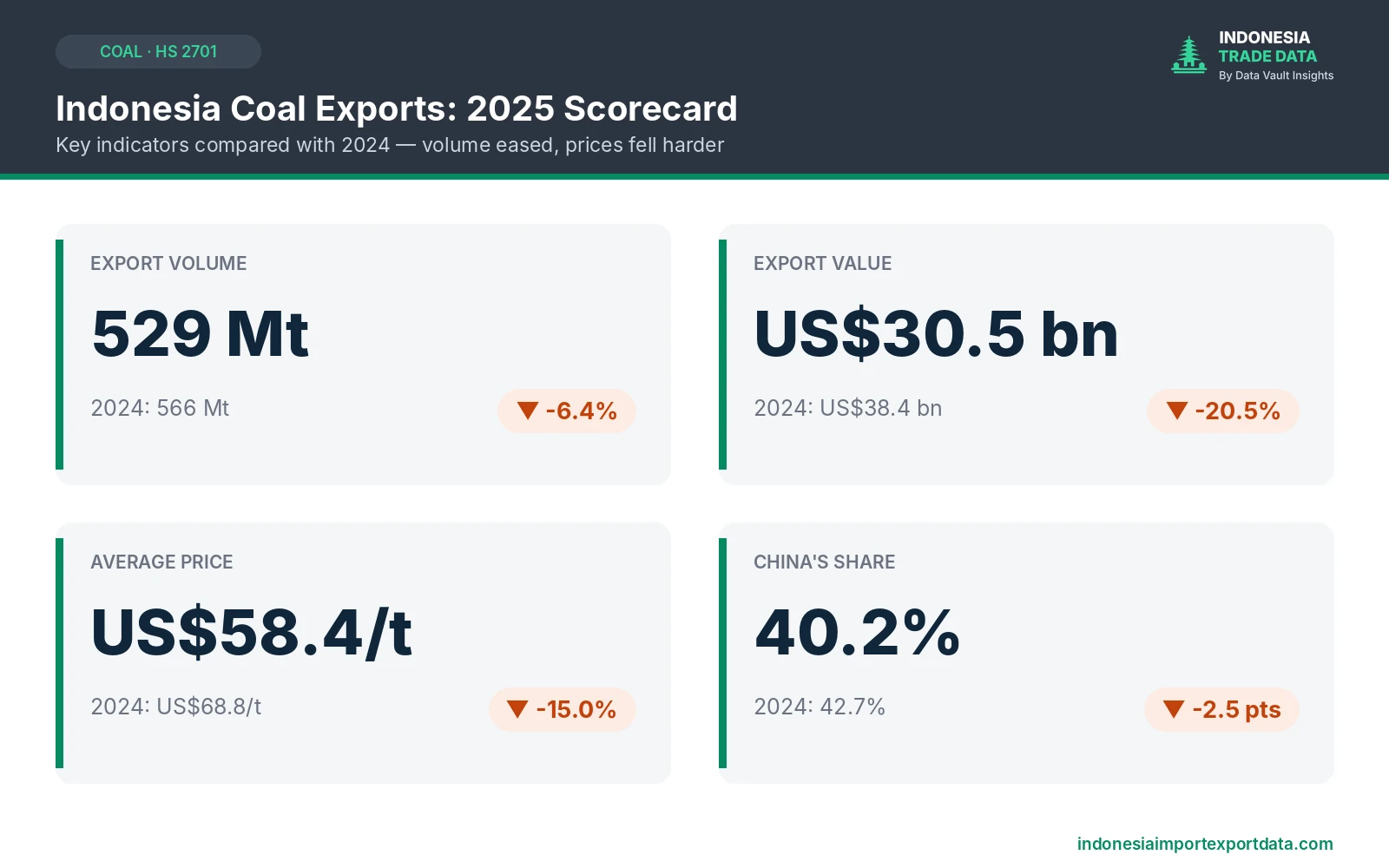
| Coal type | HS code | Volume 2025 | Share | Change vs 2024 |
|---|---|---|---|---|
| Other (sub-bituminous thermal) coal | 2701.19 | 329.0 Mt | 61.9% | -2.7% |
| Lignite | 2702.10 | 133.0 Mt | 25.0% | -12.4% |
| Other bituminous coal | 2701.12.90 | 45.6 Mt | 8.6% | -11.4% |
| Coking coal | 2701.12.10 | 24.1 Mt | 4.5% | -9.4% |
Lignite took the biggest hit. As prices fell, buyers in China and India could afford better-quality coal, so demand for the lowest grades dropped first.
Who buys Indonesia's coal?
China alone takes about 40% of Indonesia's coal, and China plus India together take 60%. Southeast Asia is the third big market, led by the Philippines, Malaysia and Vietnam.
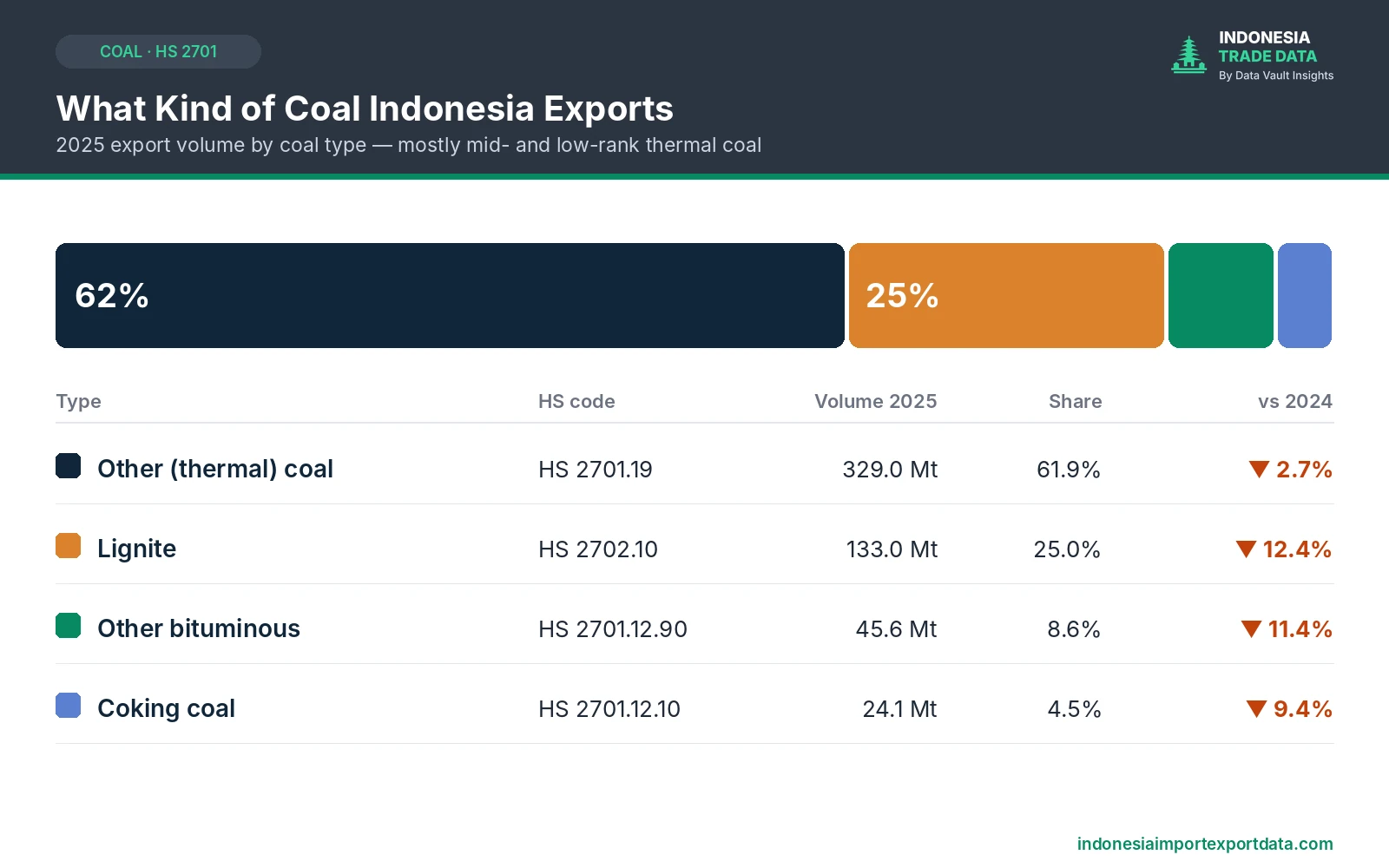
| Rank | Destination | Volume 2025 | Share | Change vs 2024 |
|---|---|---|---|---|
| 1 | China | 213.0 Mt | 40.2% | -12.0% |
| 2 | India | 105.0 Mt | 19.8% | -7.2% |
| 3 | Philippines | 38.8 Mt | 7.3% | -5.9% |
| 4 | South Korea | 29.1 Mt | 5.5% | +4.5% |
| 5 | Malaysia | 27.6 Mt | 5.2% | +1.5% |
| Others (Vietnam, Japan, Taiwan, Thailand, Bangladesh and more) | 115.5 Mt | 21.8% | – |
In value terms, China bought about US$10.2 billion of Indonesian coal in 2025 (-25.6%) and India about US$5.2 billion (-20.2%). Both countries are mining more of their own coal and adding solar and wind power, which is why their imports are shrinking. South Korea and Malaysia were the only big buyers to increase purchases.
2026 so far: less coal, firmer prices
Exports in the first half of 2026 reached 231.6 million tonnes, down 3.2% on H1 2025. But the value rose 4.5% to US$15.1 billion, because tighter supply pushed prices back up.
| Period | Volume | Change (year on year) |
|---|---|---|
| H1 2026 (Jan–Jun) | 231.6 Mt | -3.2% |
| Jan–Aug 2026 | 302 Mt | -4.5% |
| August 2026 alone | 36.1 Mt | -23.3% |
| Destination | H1 2026 volume |
|---|---|
| China | 87.3 Mt (37.7% share, +3.9%) |
| India | 43.2 Mt |
| Philippines | 19.0 Mt |
| Vietnam | 16.9 Mt |
| Malaysia | 12.6 Mt |
The decline sped up in the third quarter. A drought dropped water levels on Kalimantan's Barito River to 3–4 metres against a usual 8–18 metres, which halved barge loadings and forced some miners to declare force majeure.
2026 policy changes every coal buyer should know
| Policy | What changed | Impact |
|---|---|---|
| Production cut | National output target lowered to about 600 Mt, from 817.5 Mt | Less coal available for export; supports prices |
| Mining quotas (RKAB) | Approvals now issued for one year instead of three; some quotas cut sharply | Supply plans are less predictable for buyers |
| Domestic market obligation (DMO) | Share of output that must be sold at home was raised | Even less coal left for export |
| Coal export duty | Approved in principle by the President in March 2026; a progressive range of about 5% to 11% linked to price was indicated | Higher FOB cost; check the final regulation before signing long contracts |
| Export reference prices | New trade rule (Permendag 46/2025) separates the export valuation price from the price used for duties | Changes how export value and duty are calculated |
| Export earnings (DHE) | From 1 January 2026, exporters must keep 100% of export earnings in state banks for at least one year | Tighter cash flow for exporters; may affect payment terms |
Industry forecasts expect full-year 2026 exports of roughly 390–420 million tonnes, which would be an 18–24% drop from 2025.
What this means for buyers and exporters
- Secure supply early. Production cuts, quota delays and weather problems mean fewer spare cargoes. Buyers should lock in volumes with several suppliers rather than relying on the spot market.
- Budget for higher landed costs. A coal export duty and a higher DMO push up FOB prices, even when international benchmarks are weak.
- Large miners are steadier. Big producers have kept output fairly stable, while smaller miners are most exposed to quota cuts. Check a supplier's shipment history before you sign.
- Watch new markets. South Korea, Malaysia and Vietnam are growing as China and India buy less, so exporters should look beyond the two giants.
Find coal buyers and suppliers in Indonesia
Annual totals show the trend. Shipment records show who is actually trading. With our Indonesia export data you can search coal shipments by 8-digit HS code and see the exporter, foreign buyer, quantity, value, loading port and destination, updated every month.
Browse the Indonesian exporter directory, check the HS code list, or request a free sample of coal export data.
Also read: Top 10 Products Indonesia Exports in 2026 and Indonesia Palm Oil Exports 2026.
Indonesia Trade Data supplies shipment records only. We do not buy or sell any goods mentioned here; to trade, contact the companies in the records directly.
Want the shipment data behind this?
Ask for a free sample of Indonesia import or export records for your product.
Related articles
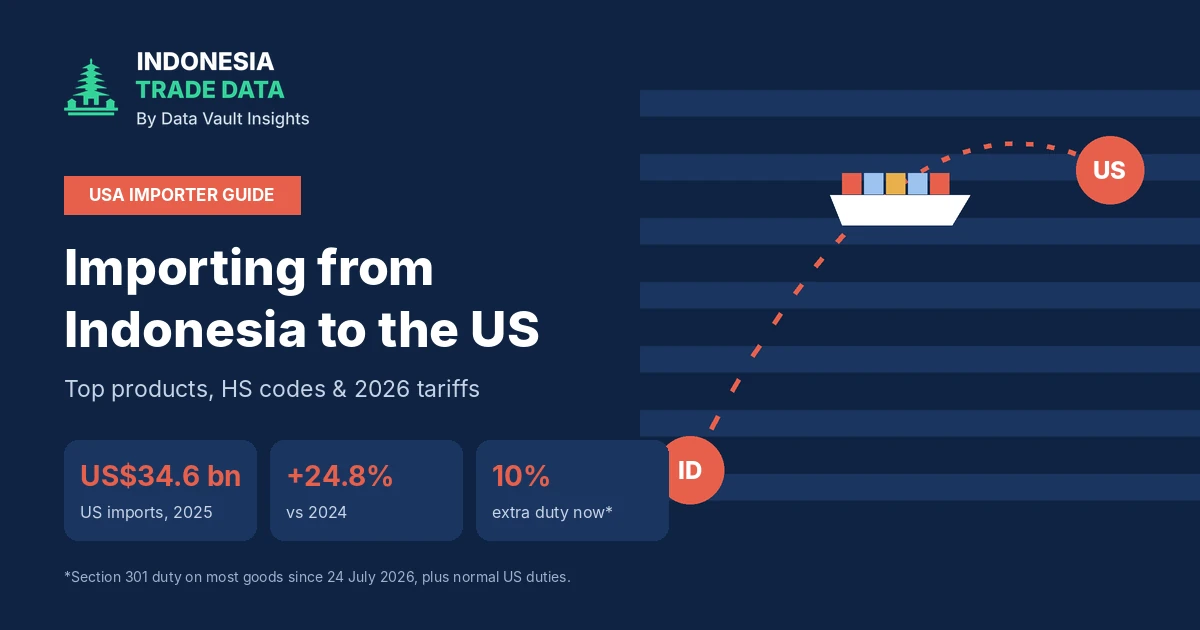
Importing from Indonesia to the USA in 2026: Top Products, HS Codes & Tariffs
The US is Indonesia's biggest Western market, with imports up 24.8% to US$34.6 billion in 2025. This guide for American importers covers the top products and HS codes, the tariffs in force in 2026, and how to find Indonesian suppliers already shipping to the US.
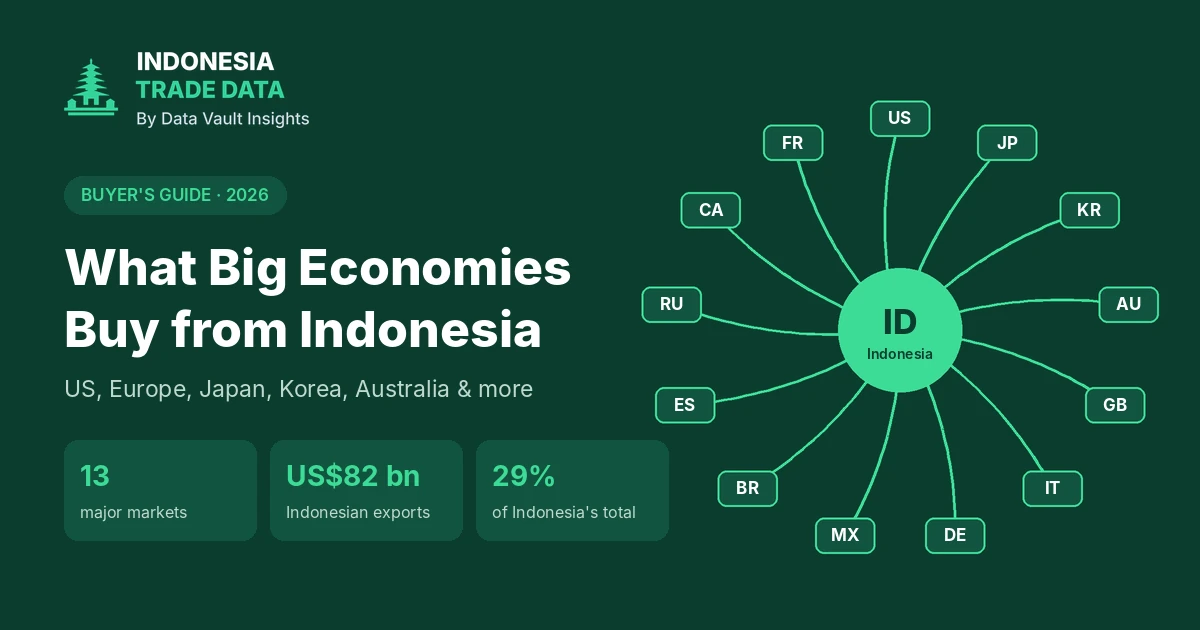
What the US, Europe, Japan & Other Big Economies Import from Indonesia (2026)
Thirteen of the world's largest economies bought about US$82 billion of goods from Indonesia in 2025. This buyer's guide shows what each market imports, from US electronics and footwear to Japanese coal and European palm oil, plus the trade deals that lower duties in 2026 and 2027.
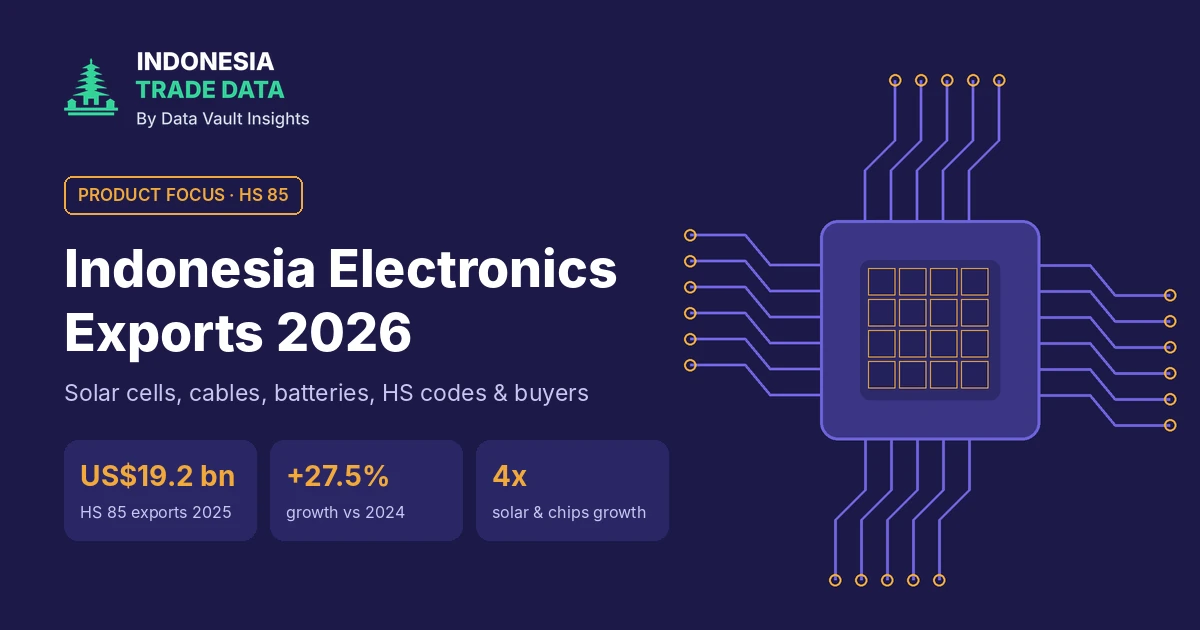
Indonesia Electronics Exports 2026: Solar Cells, HS Codes & Buyers
Indonesia exported US$19.2 billion of electrical and electronic equipment in 2025. Solar cells more than quadrupled, while phones, cables and batteries kept growing. This guide covers HS 85 codes, the top products, the main buyers and the new US solar duties.